
When an answer looks wrong
Most unexpected answers come from a different measurement, period or value type than the one you compare with. Check those three, then ask again with the name of the measurement exactly as LetsGrow has it.
Symptoms
Section titled “Symptoms”- The answer is about another measurement than you meant.
- The numbers differ from your graph.
- Growi gives an older value with its date, or says there is no data.
- A radiation value is a factor 100 off.
- A measurement you asked for is missing from the chart, or a highest value differs from the peak in your graph.
- The answer is based on LetsGrow knowledge or general growing knowledge where you expected your data.
- Growi says you may not have access to the data.
- Growi says a measurement looks unreliable and tells you to check the sensor.
Possible causes
Section titled “Possible causes”| You see | Cause |
|---|---|
| The greenhouse value where you meant another one | A bare “temperature”, “humidity”, “RH” or “CO2” means the greenhouse value, and a bare “EC” the substrate value. Say “drain EC” or “outside temperature” and Growi takes it as written |
| A measured value where you meant the setpoint | Growi prefers the measured value unless you say setpoint, target or desired |
| Values from another module than your graph | Growi reads only the modules linked to the crop. When several of them hold the same measurement, it takes the Climate Extended module for greenhouse temperature, RH and CO2, and the lowest module number for everything else. A module that has ended is used only when the active ones have no values |
| A related measurement “as a reference” | The best match had no data for the period and the next one had. The reference measurement is not drawn on the chart |
| A measurement missing from the chart | It had no values in the period. Growi draws the chart from the measurements that have values and names the missing one in the text |
| A highest or lowest value that differs from the peak in your graph | Over more than 7 days Growi reads day, night and 24-hour values, so the highest value is the highest day average, not the highest 5-minute reading. Growi says which one it is and gives its date |
| A value with a date where you asked about last night | A measurement that LetsGrow records once a day, such as dry-back, has no night value. Growi gives the daily value with its date |
| Dry-back in kg where you expected a percentage | “Dry-back” on its own means dry-back in kg. Say “dry-back %” |
| Another period than you meant | Without a period Growi reads the last 24 hours. A follow-up keeps the crop, not the period. “Last night” is 18:00 to 06:00 |
| Other dates under a crop comparison than you expected | Without a period Growi compares the whole cycle of each crop. The Period footnote lists the dates it used; check the planting and end dates of the crop in LetsGrow |
| A daily average that differs from your own calculation | The 24-hour value runs from sunrise to the next sunrise, not from midnight to midnight, and it is written after that next sunrise. See the Glossary |
| An older value with its date | The period has no values. Growi gives the latest value on record and says it is not from your period. Over more than 7 days Growi reads only day, night and 24-hour values, so a measurement without them ends up here too |
| A sum that is too low | Days are missing. An average leaves a missing day out, a sum gets lower |
| “VPD” without your greenhouse VPD | “VPD” on its own means VPD plant |
| Radiation a factor 100 off | Growi gives a daily radiation sum in J/cm² and current radiation in W/m². 1 MJ/m² is 100 J/cm² |
| An answer from knowledge, not from your data | Growi found no fitting value in your data, such as a target that is not set. See Where Growi’s knowledge comes from |
| A remark about access | A module of the crop could not be read with your account. See Which data Growi can access |
Resolution
Section titled “Resolution”-
Check the bar above the chat: is it the crop you meant? See Choosing a crop.
-
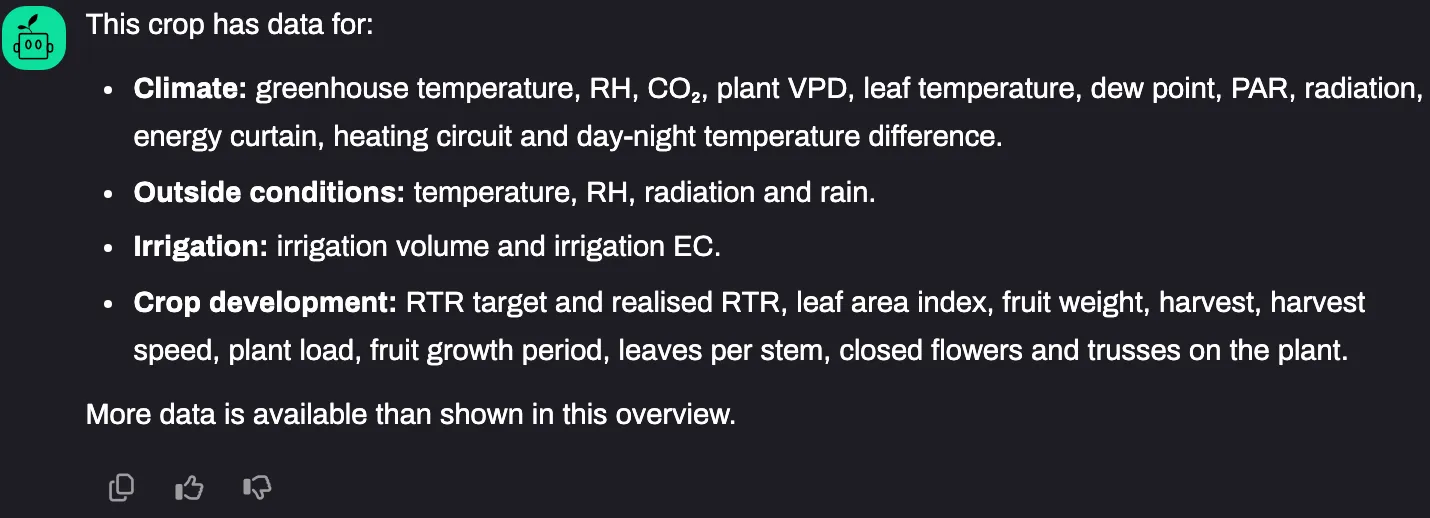
Ask “Which data does this crop have?”, with a keyword if you like. Growi lists the measurements by topic, such as climate, irrigation and crop development.
-
Ask again with the exact name from that list, or with the item code. Both select the measurement directly.
-
Name the period, and add “day”, “night”, “setpoint” or “measured” when it matters.
-
For a period that is still running, ask about yesterday. Growi marks figures for today, this week or this month as not final.
-
When Growi says the check could not be completed, ask again. That was a temporary error, not missing data.
Verification
Section titled “Verification”The new answer is about the measurement you meant, and its values match your graph for the same period and value type.
Escalate when
Section titled “Escalate when”The crop, the measurement, the period and the value type are right and the number is still wrong. Give the answer a thumbs down (Not helpful) and describe what you expected. See Giving feedback. For an access problem, contact LetsGrow.
When Growi says a measurement looks unreliable (a value stuck at zero, frozen or implausible), check that sensor in the greenhouse first, or ask your installer. LetsGrow cannot inspect, clean or calibrate a sensor. Contact LetsGrow when a measurement stopped arriving or is missing, or when the sensor checks out and the reading still looks wrong.